Showing posts with label shiv sena;kolkata. Show all posts

Saturday, September 13, 2008

Apathy, Activism and the Line in Between


The Christian community has typically been used to living a fairly sheltered and secluded life. The community has been largely till recently been spared the social ostracism that even elite and urbane Muslims have faced in times of communal violence and the poorer sections of the community have till recently been spared the violence that has so regularly lashed the Muslims. The result is a very obvious one: the Christian community has often lacked the institutional mechanism to deal with targeted attacks on the community it is still fumbling to press the right buttons, and apart from the response of human rights activists and bodies of clergy, the lay person’s response has been lukewarm. Indeed the Christian community is perhaps full of people guided by apathy.

Traditionally the Muslim response has been clergy driven and the over riding slogan has been that of “Islam in danger.” Whether Islam was in danger or not at these times, the power of the clergy probably was and that red flag provided certain shrillness to the protests that were driven by a sense of urgency. In contrast, the appropriate Christian response might have been that “Christianity is in danger” but mercifully, the resistance has not taken that route and it is good that it has been this way. The worst possible way to counter fundamentalism of one kind is to replace it with fundamentalism of another kind.

The Christian response to this kind of violence has thus far to be commended for not losing the moral high ground by also resorting to violence. This is especially so because in spite of the largely measured responses from the Christian clergy, in a volatile environment, there is always the danger of some lunatic fringe element shooting off some loose canon.

On the other hand, a better and more effective answer to rising tides of fundamentalism of any shade would be to try and enlarge the space of secular and liberal ideologies and by speaking up against all forms of communalism and sectarian and ethnic or region based violence – whether it affects one’s particular community or language group or not this time round. If it has, this time around… never mind this - there is always another time.

If one disagrees with this thesis, one need not look very far away for evidence. One will remember in that in the not too distant past, the Shiv Sena had as its target the Udipi restaurants dotting the Mumbai landscape. In fact, the Shiv Sena really came of age as a lumpen organization, out to vanquish the South Indians from the city’s landscape. Of course, once the Sena had carved out its identity, it promptly forgot the South Indians and more than a generation later, the Generation X Sena – has begun inventing itself by venting itself on the North Indians - the Biharis and the UP wallahs.

Martin Niemöller, the Nazi era, Christian theologian had it right, when he explained the dangers of looking out only for one’s own. His quote of war time Germany explaining the apathy of many in his generation concerned just with getting on with their lives… “First they came for the Jews…..” has become a lodestar for engagement with wider, liberal elements of civil society whose boundaries are wider than one’s own. Niemoller’s words were later elaborated ….

When Hitler attacked the Jews I was not a Jew, therefore I was not concerned. And when Hitler attacked the Catholics, I was not a Catholic, and therefore, I was not concerned. And when Hitler attacked the unions and the industrialists, I was not a member of the unions and I was not concerned. Then Hitler attacked me and the Protestant church — and there was nobody left to be concerned.”

In a multi-cultural, multi-lingual and multi-lingual country like India, this prophecy could be fulfilled faster than one thinks. Those who sit back today, unaffected by the plight of any one else’s but their own, comforted in their ghettos could find their security shattered very soon. At the end of the day, when all our identities are stripped down to the bone; there is only one question that remains to be asked ; one that remains to be answered… are you an inclusive person—embracing every one and their culture and belief or are you an exclusive person, with your world shrinking by the day.. as you leave out more and more and more people out of the fold because they are different …. Or are you just plain apathetic … that worst sin of all? For even an excluvist person can perhaps be won over by reasoning or argument …. but an apathetic person can pass through life unmoved by all things and every thing… till his own life is shattered by a glass pane.

Friday, March 7, 2008

Migrants are Everywhere


In the midst of all the talk about the migrants in Mumbai and whether they are a burden or an asset to the city, I came to visit my mother in Kolkata. She lives in the Ballygunj area, once (probably still), an extremely elitist old money colony of the Bengali elite. After uninterrupted Left Front rule in the state since 1977 which effectively cut down industrialization and jobs for the educated Bhadrolok class, most of the young people left the city and today a large part of old South Kolkata is decaying buildings and elderly residents. The ambiance is unmistakably old world Bengali. So it was with some level of curiosity that my mother announced that a couple of girls who spoke Hindi had come to live as paying guests in the neighboring house.

In a culture, where people are classified as Bangali(Bengali) or O Bangali( non Bengali) with no grey shades in between, the arrival of the girls who would chatter away in Hinglish is currently still an amusing phenomena as they bring in life into an otherwise deadened community. But some disquiet is clearly there. What happens next? Some more girls coming in paying guests? Boy friends? Parties and Loud music? No one quite knows and every one is keeping their fingers crossed.

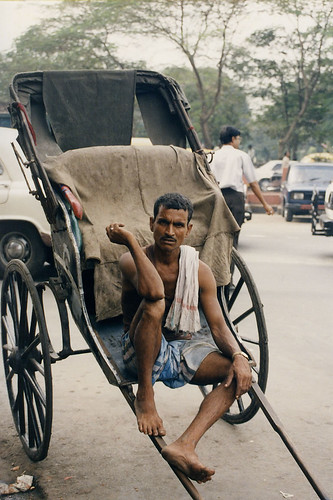
The only non Bengalis people in the area are aware of are Marwari builders trying to buy up their mansions and whose ostentatious life styles are looked upon with contempt and at the other end, the Bihari rickshaw pullers and laborers – generally looked upon in Kolkata with pity rather than anger. And yet can some Marwari families and Bihari laborers who have been in the city for generations and who speak the language and idiom with a rare fluency that will always elude the probasi(non resident Bengali) be called sons of the soil ? That question has never been attempted.

The situation in Delhi is far more interesting. The original people of Delhi – the folks who lived in Shahajanabad – Ballimaran, Chandni Chowk are today miniscule. The whole of that is captured within one parliamentary constituency out of Delhi’s seven. The others who are authentically sons of the soil are the outlying villages – Narela, Najafgarh, Badli, Samaipur and many, many others. These are and always have been villages and very rural except that the city has grown all around them and suddenly they find themselves befuddled.

The bulk of the people who live in Delhi today are migrants and a big portion are people displaced by the partition and who have come in from what is now Pakistan, gone into business, made money and bought property which they let out often by putting out classifieds in the daily newspapers. A typical transaction where the lesser is a migrant, the prospective tenant is also a migrant will reveal a lot. After scanning through the classifieds and short listing a few houses, a phone call is made to the landlord in the phone number listed in the advertisement and a time to get together is fixed.

Once the parties have got together and the opening pleasantries exchanged, the land lord asks the key question – what is you shubh naam? - Your good name please? A hush accompanies the question for in that question lie a hundred answers. If I am typical (I am not but that is a different matter…)my name will reveal to a waiting audience, not just that but my caste, my language, my religion, my dietary habits and possibly even my political ideology. It might even provide significant clues as to my occupation, my income and my life style. All this is largely based on stereotypes but when a dialogue is happening between strangers, pictures and images loom pretty large. The interesting thing about these interviews is that although a large portion of the land owners are North Indians and a big majority landed as displaced people needing housing in the post partition era, North Indians are at the bottom of the ladder when it comes to picking tenants.

Echoing Delhi’ Lieutenant Governor’s remarks most land lords believe that among migrants into the city , the South Indians are the favored lot as most believe that they are reliable law abiding, not aggressive and in general law abiding. Most advertisements are too discreet to say this upfront but some actually do so. The classification typically allows only North and South, so when I say I am from Bengal, there is momentary confusion but thus far I have passed the test. However I don’t know how Muslims with a name like Abdul Aziz would fare or a Christians with a name with Anthony Gonsalves would fare.

Eventually possibly xenophobia is ingrained in our genetic make up; but what we do differently in different places is respond more or less humanely recognizing that trade, travel and eventual migration is just as much part of the human genetic make up. Indians, who constitute one of the world’s largest Diaspora and have received varying levels of welcome at different places and even different times, should have assimilated lessons connected to migration and even reverse migration long ago. But we haven’t done that.

The Shiv Sena may say that Biharis are an unwanted lot every where and like Tejinder Khanna’s statement that maybe a politically incorrect truth. But perhaps it will take a man of Abdul Kalaam’s vision to make Bihar a more attractive place to live and work, so that a day may come when people or at least a section of them actually revert back to their place of origin. Isn’t that beginning to happen a bit – as India changes, many NRIs who went out in search of lucrative pastures outside, are now finding the grass increasingly greener this side of the fence ? Migration is a complex phenomenon- it will take a lot more than raving and ranting to make a rational sense out of it and draw up humane policies that will make it less necessary for people to migrate out into unwelcoming shores.