Showing posts with label bangladesh. Show all posts

Thursday, August 14, 2008

The Human DNA


As the violence in Jammu and Kashmir escalates beyond what bounces of our television screens, the vibrations are also cascading across our borders. Pakistan has of course reacted harshly to the “excessive use of force” to control the civil unrest there and in a typical knee jerk response, the Indian government has condemned the comments from the Pakistani Foreign Minister as an interference in India’s internal affairs.

Of course there is this much to be said in that all countries in the sub continent are from the same genetic make up very literally and all can be blackened with the same brush. A lot can be perhaps said about Pakistan or any other country around making pious statements about human rights considering the overall record of every one here. But still the question begs to be asked – when do political boundaries blur and our human identity begins asserting itself?

When do we feel free and are given the freedom to express a genuine agony and anguish at the violence, broken and bereaved families that every unplanned funeral brings in its wake? This is not about fishing in troubled waters or scoring political brownie points at all. But I wonder - does it become treason to mourn the loss and grief of another because they live across a border that is not even a century old when cultural and ethnic bonds go back a thousand years or more?

When a lament from a neighboring country at the violence that is prevailing here and is flashing globally across television channels and internet news sites is understood to be interference, then the question arises for Indians as to what should they do. People with ethnic backgrounds and languages spoken in India live in all countries that surround us – Bengalis – even Bengali Hindus (for those whom this distinction matters) in Bangladesh, Tamils in Sri Lanka being the most prominent but by no means the only ones.

It seems easier to reach out across borders when natural disasters strike – like tsunamis or earthquakes or cyclones; but some how there is an insurmountable barrier when it comes to even making statements of empathy and condolence when the tragedy is manmade.  Even a word can impute a motive when at least at the level of the common man or woman, none is intended,

Most of us are it the political establishment or those who are part of civil society will find it well nigh difficult to look the other way in the guise of non interference in the internal affairs of another country. If Tamils were to be in the midst of widely publicized media footage be subjected to violence or the Bengalis were, it would be politically inexpedient to sit back and do nothing.

If non interference in the affairs of others is the norm, then nobody in the international community should be speaking into what is happening in Zimbabwe, or Sudan, and India itself should not have moved resolutions in the United Nations when South Africa was still practicing racism. But it is good at times, indeed necessary for people to speak up, take note and make a point in the international communities and forums so that what would otherwise have gone unnoticed and remained hidden in shadows

Of course there is such a thing as undue interest in the affairs of another country; as perhaps best exemplified by the US invasion of Iraq. But there is also such a thing as too little of an interest in the affairs of the world. After all, it is only those who live in glass houses who are scared of stones and so they do not throw any. The world’s largest democracy should not be fighting shy of facing criticism when there are plenty within the country’s own borders who are concerned. Let us own up to the fact there is a common human DNA that makes us all speak up.

Tuesday, May 13, 2008

The Money Plant

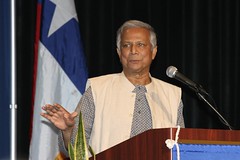
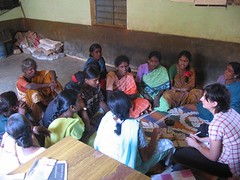
Ever since Muhammad Yunus won the Nobel Peace Prize for his initiatives in micro finance, the sector has been attention that had hitherto been denied it. The Professor himself has been toasted around quite a bit and the Grameen Bank has now been invited to set up shop in Assam. But the success and spread of micro-finance in India has been patchy and mostly confined to the South Indian states where there has been a long history of thrift and credit societies and then subsequently of Self Help Groups. Typically micro finance programs have had three common characteristics in India at least –a) they have been women-centric, b) They have had an NGO non profit mindset, which has meant that business viability has been undermined) They have had a rural focus.

“Experience shows that microfinance can help the poor to increase income, build viable businesses, and reduce their vulnerability to external shocks. It can also be a powerful instrument for self-empowerment by enabling the poor, especially women, to become economic agents of change.”

But micro credit has had a very limited audience to play to. In the highly patriarchal societies of North India, where women rarely are allowed out to step out of their houses, let alone assemble in groups; the gender skewed methodology of first forming groups of women and then offering loans would not work. Neither would they typically work in highly urban societies which lack the homogeneity of rural communities and the system of trust and honor on which the foundations of repayment and low defaults are built. But to scale up and really make a difference to those outside the normal banking channels, microfinance institutions need to innovate.

As Vikram Akula of SKS Micro Finance puts it, the three key issues that a micro finance institution usually faces are lack of capital, the lack of capacity and the high cost of transaction. Ahuja, who started life as a Field Officer for an NGO driven microfinance program has the answers - answers which prompted him to start his own micro finance company with an entirely different set of paradigms than the one he was first coached in.

Vikram Akula talks the language of business - of generating capital by earning profits for investors, of not being content with a couple of thousands of clients, but in terms of millions of customers as any good sized business would have and in terns of using automation and technology to manage the high cost of several tiny sized transactions. He is currently doing a pilot using mobile phone technology to manage transactions. The penetration of mobile phones among SKS’s clients is adequate enough for Vikram Akula for it to be a viable option.

Does speaking the language mean that a microfinance institution has to forsake its social obligations? Not so. Shikhar Development Services is a newly formed microfinance entity that is trying to combine sound business practices with socially relevant innovative projects. Working in an urban environment with its own particular challenges, they recently conducted a survey which revealed that many parents with school going children had a significant cash outflow in the months of April – May when the school academic year started. Often the parents would not have the cash necessary to make the pay out and the child would drop out of school. Appalled at the finding, the company is now looking at the feasibility of developing a loan product that would enable parents to meet this predictable yet unaffordable financial need.

MFIs might have entered the picture with the aim to bank with the “unbankable” and often received societal support because they were perceived as removing the scourge of the money lenders. But today they attract a fair bit of criticism too and many feel that some microfinance institutions are blurring the line between constructive microfinance and exploitative money lending. There is also criticism that easy access to credit doesn’t seem to have made any perceptible change in the lifestyle and livelihoods of the rural poor and that at the cost of the poor a large number of MFIs have benefited; banks have found a convenient route to increase lending; and corporations have got a growing consumer market to target.

As more and more microfinance institutions enter the market, they would need to be ready to respond to such criticism and innovations and social responsiveness would become more and more necessary, both to compete and to stay socially relevant. Unlike the typical banks – brick and mortar structures where customers have to visit to access products; micro finance institutions have people on the ground close to their client base to listen, reflect and constantly innovate; a luxury that the typical banking institution does not have. Compared to Bangladesh, where the market as well as the clientèle has become more discerning; India is a relatively nascent market. Many will be waiting to watch to see if MFIs become hand maidens to established commercial banks working towards “financial inclusiveness” or manage to retain their independence and their soul.

Thursday, June 14, 2007

Cartelization of the Environment

In the Biblical story of creation, after God creates man, He gives to man (and woman) the mandate to be a steward of the creation which they have been privileged to enjoy and to preserve and care for it. Sadly, this has often been breached and most often by those whose civilization has been shaped by the Bible and what it teaches. The recently concluded Heiligendamm summit of the G-8 nations provided a good opportunity for those nations who have the biggest political influence in the world to address the issue of climate change seriously. It was actually the main item on the agenda, the main course on the menu. It is therefore a pity that that the agenda of the main summit got some what hijacked by the simmering differences between the US and Russia on missile defense and the fact that this was British Prime minister Tony Blair’s last major global conference before he steps down.

While nations who have the power to make things happen and are effectively the globe’s movers and shakers chug along merrily and keep deferring making real choices and decisions , the countries where the climate change is going to hit the most and the earliest have no voice at all to voice their concerns except activist NGO environment groups. Although the methods that many of these groups use to garner attention may arouse distaste, there is no getting away from the facts.

Take for instance, Bangladesh. The media there has been raving and ranting about the effects of climate change and global warming and its effects which the country will feel pretty early. Also, unless action is taken pretty quickly, many of the changes will be irreversible. the impact of the climate change, the sea level use will lift up 100 cm at the end of the 21st century and flood 15 to 17 per cent land of Bangladesh that will make about two crore people in the country homeless.

There are also effects expected on the economy. Rising levels of Carbon Dioxide in the atmosphere has begun to affect crop yields. Production of main food crops like rice, wheat and potato will deplete steadily as the climate changes more and more, and by 2015 Bangladesh, along with neighboring countries, may be forced to look for new brand of crops. Food insecurity in a country where famine and starvation deaths are part of the collective psyche is or should be a cause of concern.

Two things disturb me as I read all the literature coming out of the G-8 summit and as I recollect all that I heard about in Bangladesh about the concerns surrounding the whole climate change issue. One is that we in India seem to be intoxicated by the short term goals of high economic growth and are part of the villains in this whole game. Along with China, the USA, Japan and Australia, we appear to be part of a cartel who would like to veto any attempt to adopt a target for emissions cuts, however inadequate. Experts reckon that we need to cut emissions by 80 or 90 percent, and by 2030, to have any chance of keeping global warming at levels where damage can be minimized.

The other disturbing element is that states like Bangladesh and other nations from the two third world do not seem to have a voice in forum of worth. They do not get invited to chats over power lunches in the G- 8 summit or the World Economic Forum and with a weak(and currently care taker) government, the voice of those who are going to be most effected like the fishermen of the Sunderbans is never going to be heard.

What is interesting to me in al this is not that a few industrailaized nations or industrializing nations have ganged up to safe guard their narrower national interests but that India is a part of this cartelization of the environment. Till not too long ago, there was another grouping of nations that was active on the world stage and that was the Group of 77 and here India provided active leadership in this forum of the two thirds world. At that point, we in India loved to identify and sniff out the foreign hand – or more specifically, a particular foreign hand. Now when did we switch sides and become an ally of those very same foreign hands that we so loved to hate. Clearly the world is changing as rapidly as the environment around us.

Tuesday, June 5, 2007

The Old Scourges are back !


Two news items caught my notice this last week, because they were the kind of news that I would normally expect to read in medical thrillers. The first related to an alert relating to a small pox alert in India’s North East based on reports reaching India about possible cases of small pox in Myanmar and Bangladesh. Officially , the disease has been eradicated in one of the most successful of public health interventions and in whose footsteps , the polio eradication program, stuttering and sputtering has been trying to follow. The second item pertained to the US authorities quarantining an Atlanta based lawyer , who was having tuberculosis and nevertheless boarded a trans Atlantic flight to Greece, potentially infecting hundreds of people in the process.


In my school days , the visit of the small pox vaccinator was a dreaded affair. The class teacher would line up all the students , and one by one , we would be called forward to receive a jab on our fore arm , that would artificially induce a small pox sore. Unlike other vaccinations we received , where the pain of the injection lasted only a moment , the small vaccination was an enduring agony


That one tiny sore would over days swell and redden and then as it would begin to dry up and form a scab , it would led to an unendurable itch. The torture was in waiting for the scab to fall off without scratching and in learning to have baths and showers with the arm extended , so as to prevent the sore from getting wet. The consolation was that if we coped with that one sore, we would never experience the real agony of small pox. What that might mean, came through to me in a much milder form when in adult life , I suffered from chicken pox which most contract as children but which some how had escaped me.


Today’s children have never experienced the small pox vaccinator and of course small pox is eradicated or so we think. And in America , Tuberculosis is as good as eradicated and their society is unfamiliar with what it is even though TB kills about 1.6 million people a year worldwide, including more than 1 million in Asia, 400,000 in Africa and 100,000 in the Americas and Europe. India incidentally has the world’s highest TB toll.


One can barely imagine the devastating effect that small pox will cause , if it has really come back to haunt us. Consider this: While vaccination for small pox was in full force , Smallpox was responsible for an estimated 300–500 million deaths in the 20th century. Smallpox epidemics could involve scores, hundreds or thousands of cases – the highly contagious nature of variola and its gruesome possibilities made number crunching relatively unimportant. Indeed, in colonial South Asia the discovery of a few cases was often considered to represent a prelude to the unraveling of a crisis that would inevitably result in further infections and innumerable deaths; while large-scale mortality was usually considered to be an affirmation of the dangers expected of variola, a less dramatic toll on human life was generally celebrated as an instance of good fortune.


The news about the occurrence of small pox is still not confirmed but the story of the Atlanta lawyer who had a virulent form of tuberculosis is true. While typically in India , we worry about “multi drug-resistant'’ TB, which can withstand the mainline antibiotics isoniazid and rifampin, the quarantined man was infected with something even worse - “extensively drug-resistant'’ TB, also called XDR-TB, which resists many drugs used to treat the infection.


Rich nations have typically ignored diseases like tuberculosis as diseases of the developing world and little funding has typically been made available to the “diseases of the poor”.Government funding for public health campaigns (TB, AIDS prevention, sexually transmitted diseases and obesity) pales by comparison with the billions spent by pharmaceutical companies on disease mongering intended to increase the markets for their products like Viagra. As the developed world discovers that in a border less world , no society is ever fully insulated and grapples with a case of XDR-TB for which there is no treatment because the existing antibiotics don’t work and no new antibiotics exist because no research has been done in what was always considered a poor man’s disease , it can only be hoped that rich and prosperous nations will be forced to visit and take into account the poor man’s world.

Monday, June 4, 2007

When the Caretaker Stays On !


Bangladesh is being governed by a caretaker government since the time Begum Khaleda Zia resigned as Prime Minister in October 2006 when her term settled down.…… after initial hiccups the caretaker government has settled down now since January under the leadership of Fakhruddin Ahmed , an economist and a technocrat , a sort of Bangladesh’s answer to Manmohan Singh. Like our Prime Minister, the Bangladesh Chief Advisor (the nomenclature for Prime Minister in the care taker government vocabulary, is widely respected. The care taker government’s role typically in previous incarnations is to hold free and fair elections to the national parliament, much like holding elections to state assemblies in India under President’s Rule in India.

This is all fine except that Bangladesh has been under caretaker government rule since October 2006 and the elections that are the main mandate of the care taker government have been announced in the end of 2008, with the specific dates still not yet announced. Surely a long time to do baby sitting! A fact worth noting is jus as Manmohan Singh is believed in many aspects of governance to be beholden to his Party High Command, Bangladesh’s Chief Advisor , Fakhruddin Ahmed, is believed by many to be equally beholden to his high command , General Moeen U Ahmed, the Chief of the Bngladesh Army.

It sems that the reticient general loaths the politicans of the kind that are available in bangladesh at the moment and wants to lend as much teeth and time to the care taker government to not just conduct elections but clean up the political scene, hopefully for good. in a enviornment where the Chief Advisor and the Army Chief are apolitical and largely neutral , they have gone after the leaders of both the political parties in the country with equal vigor by jailing leaders from both sides. Though , none of the two Begums Khaleda and Hasina , by disempowering their inner coterie, the government hopes to render them ineffective. The care taker government seems to have learnt its lessons from Pakistan, where exiling Nawaz Sharif and Benazir Bhutto did not lead to any significant lessening of their influence. Here the strategy seems to be wakening the widely party hierarchs perceived to be widely corrupt from with in.
Many of the reforms that the care taker government are carrying out are good and laudable and should typically have been done by a regular elected government with a mandate to do so. It is a pity of course that they did not. Now the question facing Bangla and the larger global community is this : Does the fact that the current regime is acting with the best of interests to all intents and purposes and doing things that seem to have poular sanction provide it with legitimcy to stay in office indefinitely. Is being democratically elected the sine qua non of legitimacyor is there any other? As Bangladesh's own history proves and examples will be available from India too, the so called democratically elected governments can be ruinous and benevolent despots like Lee Kuan Yew can be tarnsformational. As the story from Bangaldesh proves , a nation some times has to confront the question – Is a country better off under a benevolent caretaker manager than a tyrannical democrat ?

Saturday, June 2, 2007

Aam Border for the Aam Aadmi


Those of us who bemoan long immigration queues at Delhi or Mumbai airports should try out the experience of a land border crossing and savor the experience. I would recommend the Changrabandha- Burimari land port on the Cooch-Behar – Lalmonirhat sector of the Indo-Bangladesh border. Most of those who use this border are from the lower socio-economic class though a few wealthy Bangladeshi people on their way for a vacation to Nepal or Darjeeling. The Siliguri – Dhaka bus uses this route and some people use that bus. Most use the run down buses from Siliguri, cross the border on foot and then resume their journey in the some what better maintained Bangladesh buses. A few arrive by air from Bagdogra and then change into a taxi at the airport and then trundle into the border village. And there the fun starts.

The first official point that one encounters at Changrabandha – the Indian side of the border is the customs outpost. Except that you have to first go through immigration. And the immigration at the Changrabndha border is a preview of hell hole. The immigration operates from a thatched hut tucked away in a corner. The staff has out grown the hut and currently half the staff operates from the open air out side the shack. Without any fans and electricity, in the stifling 40 degrees heat, with crowds milling every where, luggage piled up in every available vacant space, the place is the very definition of chaos and yet things happen.

The West Bengal Police, who man the counter, collect a bunch of passports at a time. As the passport disappears into one cavernous hole, one is forced to keep two eyes and one ear open. One eye on the passport in case you can distinguish it from among a mass of others, another eye on your luggage and an ear open for when the immigration clerk will call out your name. Once in a while, a white man walks in and the crowd parts like the Red Sea once did for Moses. The pecking order for immigration seems to be European and US passports, then Indian passports and at the bottom of the pole are those with the Bangladesh passports.

The immigration officer’s cross examination is cursory. I am asked my profession and when I say doctor, he says that his mother in law has high blood pressure and what would I advise. I suggest a salt restricted diet and he looks happy and waves me on to the counter where the passport would be stamped. Most of the work here seems to be done here by unemployed local youth who act as facilitators for many of the travelers who are illiterate, helping them fill the immigration forms.

The official staff is there to sign and stamp and with their outsize stamps, they take up a lot of space on the passport. How the immigration function without any fans, forget air conditioning and how they might be functioning in the monsoon is any one’s guess. The immigration process is all manual, so there are heaps of ledgers and notebooks and rubber stamps all around, plenty of stuff to take care of in case of a sudden down pour.

After immigration is the customs and they have their own out sized stamp. The customs operate out of a room which is a little airy and it has a fan. A local boy informs that they don’t have an official connection either but they have made “arrangements” with the local electricity board and pay their bills with the” offerings” that come their way. Again the customs stance seems to be tougher on the Bangladeshis than on the Indians.

Finally, there is the Border Security Force, the land border’s version of the airport’s CISF. No X Ray machines or scanners here of course, so every thing is searched physically. The earthy hands of the BSF jawan will string out your underwear, toiletries and any other thing that you might be carrying looking for contraband or bombs or grenades or what not.

Some where in this process, you have to change your money and you have to make your way to the money changers. No Thomas Cook or Amex here, just tin roofed shacks with bespectacled munshi type characters wearing soiled vests with holes in them for exchange rates that are all their own. They may be sitting in the one horse village of Changrabandha but they deal not just with Bangladesh currency but with Dollars, Pounds and Euros and their exchange rates are all put up with a stick of chalk on a faded black board.

Finally, after dealing with immigration, customs, BSF and the money changer, you cross the border on foot. No luggage trolleys here , so you put the luggage on your head and cross the no man’s land or get some help from the Bangladeshi coolies , who have some how the permission to come to the edge of the no man’s land , pick up the luggage and carry it into Bangladesh. And once you are in Bangladesh, drenched in sweat by the nearly hour dealings with one set of officials, you wipe your brow and begin again with another set of officials – this time, the Bangladesh set. A memorable border crossing indeed… an Aam border for the Aam Aadmi!