Wednesday, February 20, 2008

A Hasidic Parable Retold


"We are the Pilgrims, master; we shall go
Always a little further: it may be
Beyond that last blue mountain barred with snow,
Across that angry or that glimmering sea
,"

Once upon a time, there was a Rabbi who lived away in a far away town. His father too was a well known Rabbi, known for his scholarship and had a large and devoted following. The son like many others had studied with his father and after finishing his studies, a wife had been found for him and he was being groomed to occupy his father’s seat in time. All was fine. Or so it seemed.

But the young Rabbi led a disturbed life. He did not sleep well and had dreams every night – of a country far away where he had his home and family where he really belonged and that his familiar home and family were strange places. He did not want to worry his wife, but he confided in his father but the old man’s prayers and ministrations did not seem to make any difference. The dreams continued and in fact increased in their intensity.

So one day, in the dead of the night, the young Rabbi crept away from his home, in search of the town and the house that he always saw in his dreams convinced that it was there that his true home lay. He had enough clarity in his dreams to seem to know the direction in which he needed to go; he set out with sure footed steps trying to cover as much distance possible before day break.

He covered as much distance as he could before the sun rose making it too hot to carry on any further. He found a shady tree, took off his bundle to use as a pillow and carefully set aside his sandals by his feet pointing in the direction in which he was to go and lay down. He was tired and for the first time in months, he slept well with no dreams to disturb him. When he woke up, the day was pretty far gone and he hurriedly opened his bundle, had his meager lunch of bread and cheese and threw a crumb at a friendly pup who had joined him under the tree at some point of his reverie.

He hurried up because he wanted to reach before sun down. And as he speeded up, he could gradually identify landmarks that he had seen in his dream and realized that h was not very far away. Finally after walking a couple of hours more, he recognized the house that he had seen in his dream. He walked into the house and was received warmly by his wife and the rest of the family; but strangely no one seemed surprised. The wife was the one he had seen in his dreams but her she seemed only mildly curious. After dinner in his new house, he went to sleep again and for the first time in months, he slept undisturbed.

When he woke up, his father was at his bed side. But his son was confused; for had he not traveled a whole day to the town and house which he had recognized in his dream? The old Rabbi sat down with his son for a final lesson. The house he was in and the house he had seen in his dream and the one to which he had walked was the same. But till now, it was his father’s house where he had a son’s privileges. After the journey that he had made, it was no longer his father’s house where he was the son; it was now his house where his father also lived. What his house was till now because he was born there became doubly his because he had now walked there on his own two feet. The truth that was his till now by virtue of birth and inheritance was now doubly his because he had discovered it for himself and he explored it with a spring in his step and a vigor that he had not known before.

Traditions and values are like that. Parents may teach them to their children, schools and social institutions may “teach” social norms, values and practices; but to be taught me not the same thing as to learn and to be introduced to the tradition and practice of one’s fore fathers is not the same thing as the initiate having embraced it for himself. That journey is seldom encouraged; we are all scared that a journey of discovery may push us or those we love off the precipice and we may never see them again. And it is true; we may not.

Letting go with the hope that our loved ones will find the values, priorities and options that we have come to cherish on their own steam, wearing out their sandals on the journey but eventually getting home is a scary proposition. And so we take the easy way out; clip their wings and cripple the limbs so that they can only hobble when they could gallop, flutter when they could soar away into the sky, but crippled and lame they may be, they at least stay within our short sighted line of vision.

“We travel not for trafficking alone;
By hotter winds our fiery hearts are fanned:
For lust of knowing what should not be known
We make the Golden Journey to Samarkand
.

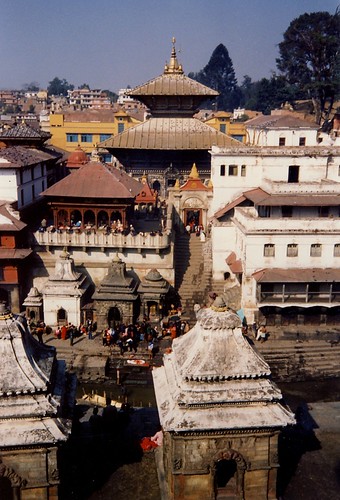
Nepal : Staggering out of the Incense Curtain


Some pieces of news make for extremely sad reading. Like for instance the one about Nepalese Prime Minister, an atheistic Prime Minister of a state that was once the world’s only official Hindu State and is now slowly evolving in leaps and jerks into a secular state. Koirala, described by the Indian Express as a senile, aging leader who refused to perform religious rituals at his parents’ deaths now wants to sit on the throne on which the kings sat and have the priests recite the “Saraswati Mantra”.

When the priests who ceremonially perform the rites, the head priest and the deputy head priest did not turn up, they were suspended. The irony of the situation was that these worthies did not turn up because in one of the gyrations of Nepal becoming a secular state from a Hindu one, the priests had already been suspended and had not been receiving their salaries. Unfazed by the irony though, the bureaucrats surrounding Koirala suspended the priests all over again lest the Prime Minister be angry.

B.P.Koirala could be ageing and senile but he is only mirroring the identity crisis that his country has and is going through eroding centuries of stability. In the days of the king- despot or not, things were clear. The King was regarded, by the common people at least, if by no one else as the living incarnation of Vishnu and maintained that appearance by residing in the Narayanhiti palace named after the deity and presiding over all key religious rituals of state. The astute King Birendra managed the balancing act between statesman and spiritual head well but his successor obviously hasn’t dome so well and egged on by the Maoists, the country has proceeded to throw away the baby as well as the bath water and is now throwing away not only the monarchy but the identity of the state itself without adequately under girding itself.

Of course a secular state itself is not a bad thing. Ideally, a secular state with separation of religion and government is preferable in most circumstances; a theocratic state can be either obscurantist or fundamentalist and both of these are menaces best avoided; theocracy in government has only one purpose – to manacle and shackle its people. And so while the resolve to start upon the journey to create a secular state is a good one, without adequate preparation, Nepal’s situation will not be very different from that of it Prime Minister- confused and unprepared to face reality and hiding behind centuries of tradition.

In a nation’s history, the journey is as important as the destination and the process has to be incubated and allowed to evolve. India’s own 60 year old journey is a good example Through Nehru’s rationalism, then soft Hindutva , hard Hindutva, debates on Raj Dharma and all that, we have arrived at an Indian road to secularism… and no the process is still not finished ….. political evolution of a State is forever a work in progress.

Its is to be hoped that the Maoists in Nepal will not be in so much of a hurry to abolish religion. May be they should do away with the seedier aspects of religion but leave alone the only roots that people cling to that give them solace. The sight of an ageing Prime Minister calling for religious Pundits despite his avowed atheistic beliefs is an indication that behind the senile exterior of the Head of government, lies a Nation’s yearning.

Baabul Moraa........ The Lament of Exile


Baabul Moraa, Naihar Chhuuto Hii Jaae
Chaar Kahaar Mil, Morii Doliyaa Sajaave.
Moraa Apanaa Begaanaa Chhuto Jaae.”

O father, I depart forcibly from my home
Four men gathered to lift my palanquin
My loved ones will become strangers
The innermost portals of my home will be unreachable

Generations of Indians must have grown up on this haunting thumri in Raag Bhairavi since K.L.Saigal immortalized it in the 1938 film, “Street Singer”. Not many may know its history and source; typically it has become exemplified as a folk melody associated with Vidai rituals when a bride leaves her father’s home for her husband’s home.

I thought the same too; till a stray paragraph in a book I recently read and reviewed by the name of “Those Days” indicated that the truth might lie some where else and that the lingering melody is actually a song of lament – a dirge, if you will at being hounded of home and hearth, never to return again. The lament is that of the last Nawab of Awadh, Wajid Ali Shah, whose life and times have been immortalized by Satyajit Ray in Shatranj ke Khilari. The origins of this composition and its composer - the epicure Wajid Ali Shah - are not as well known.

Wajid Ali Shah wasn’t probably much of a king but he was surely an artiste and a connoisseur and his lament at being exiled out of his beloved Lucknow, was the first modern original inheritance of loss that is recorded. In fact the annexation of Awadh or Audhas the British spelt was one of the events that led to the first war of independence in 1857. That he was popular enough in his own way is evidenced by the fact that when his royal caravan left Lucknow, the poets of his court lamented the exile of the Nawab as follows:

Lucknow bekas huwa Hazrat jo-gaye,

Fazle gul kab ayegi, kab honge aakar naghma sanjh,

Ek muddat ho gayi murgaane gulshan ko gaye”

One’s roots and ancestry is a strange thing. Whether it is a forced migration as it was in the case of Wajid Ali Shah or a voluntary exiling of one self for the sale of a better life as it is often the case today, there is an inner lament that may never find proper expression in words unless one is a writer of some kind. it is possible that Saigal’s song found the enduring popularity it did with just a tabla and a harmonium as an accompaniment because its heart tugging words pulled a chord in the heart of every body who has felt alienated and the strange foreboding that one is bidding farewell to a familiar territory.

There is an anecdote about the song composed by Wajid Ali Shah got into a Hindi movie. After the British annexed Awadh, they exiled him to the Metiaburz suburb of Kolkata, where he established a mini court with some pomp but no glory. There he tried to recreate the fabled charm of his legendary Lucknow and his mehfils were the favored destination of the Kolkata aristocracy.

The Nawab’s dirge was often sung there and though much of the pomp of the court vanished after Wajid Ali Shah died in 1887, the song remained on the repertoire of the musicians lamenting their own fall from grace. It continued to be sung in the progressively decaying music concerts of Kolkata, till Rai Chand Boral, the producer of Street Singer chanced to hear it in one of them and decided that it was just fitting for K.L.Saigal and the film. History has of course proved him right.

Finally of course, those who have read the biography of the Last Mughal by William Dalyrymple will know that Wajid Ali Shah wasn’t the last to die mourning the inheritance of his loss. Bahadur Shah Zafar, one of whose honorifics was jahanpanah (the shelter of the world) was exiled out of Delhi’s Red Fort to distant Rangoon and die lamenting that the one who once provided shelter to the world did not have luxury of being certain of a few meters of ground for his burial and a few yards of cloth for his shroud. If you have read the first few chapters of Dalyrmple’s book will know how the emperor was eventually buried. Loss is a strange phenomenon. It spares nobody. May be those boarding those crowded trains to get out of Maharashtra will not know but the eviction game has happened before. And will keep happening again and again.

Wednesday, February 13, 2008

Urdu Poetry at a Funeral

“Isliye rah sangharsh ki ham chune/Zindagi ansuon me nahae nahin/Shaam sehmi na ho, raat ho na dari/Bhor ki ankh phir dabdabai na ho

(We must choose the path of struggle, so life shouldn’t get drowned in tears. The evening shouldn’t get enveloped by awe and night shouldn’t be fearful. And the dawn shouldn’t crack with tears welled up in its eyes)

I like revolutionary poets for some reason; especially the Urdu ones. The Urdu revolutionary poets were giants – Sahir Ludhianvi, Kaifi Azmi, Majrooh Sultanpuri, Faiz Ahmed Faiz and all the rest. I don’t know what it was in that generation that produced so many giants in progressive poetry; but their sheer power, beauty and idealism is itself awe inspiring, even if some of their Persian rich vocabulary is a bit difficult for those of us for whom Hindustani is not the first language.

I do not know who out of these eminences composed these verses that activists sang at the state funeral of Baba Amte the other day. The Indian Express does not report this, but I am amused and also touched that activists and the State who rarely sleep on the same bed ever, got together at the funeral of the giant that Baba Amte was. If I am correct, it was the first State funeral of a private citizen in a long time – perhaps the first after Mother Teresa. And while the Baba looked grand wrapped in the Tricolor, it is a bit ironic that no one thought in the establishment seems to be have thought of honoring him with the Bharat Ratna while they were squabbling abut other octogenarians who were in the race.

“Haath lage nirman me, nahi marane, nahi mangane (let’s use our hands to create, not beg or beat)

I don’t know who wrote that piece either. I read those lines about not using our hands to beg or to beat with supreme irony. While Baba Amte’s body was being lowered into a pit in Anandwan in Maharashtra, in the state’s capital of Mumbai; North Indians who had come to work in the city because they did not want to beg were being beaten into submission and occasionally into death and destruction.

Aggression is every where and those Urdu poets had it all wrong. They wrote poetry to inspire revolutions and willed struggle for themselves, so that there would be no tears for the others to drown in. but we have turned the phrases all upside down. We are in more and more moving towards a society where the others struggle and it is our design increasingly that if it is possible at all to live a life that is free of tears , than that life should be ours.

It is ironic that the last movement that Baba Amte was involved in was called the Bharat Jodo or the Knit India movement. Pity that he was too old by then for the movement to benefit much from his leadership and there isn’t any one it seems who will effectively take over that piece of the Baba’s work. For in the midst of a Bharat todo movement, a Bharat jodo movement is much more needed than ever. As discordant voices and slogans rend the air and people talk of distributing sticks and swords, Baba Amte must be turning over in his grave. Very literally.

Thursday, February 7, 2008

Gender Imagery and Advertising

For years, we have been used to seeing a certain kind of advertisement- especially advertisements from the financial sector. The advertisements would exhort you to save, so that there was enough in the kitty for your daughter’s wedding and of course enough to fund your son’s education. The financial planner’s marketing buzz was to make these basic inquiries and then suggest a savings plan to meet those goals.

But for some time now I have been watching a series of advertisements which go against this grain. In one of them, the daughter of the house comes lamenting that she has secured admission in a good university abroad but doesn’t have the resources to pay the fees and her scholarships will not pay the full amount. Various alternatives are suggested including a loan from a wealthy uncle but they don’t find favor. Finally the father hugs his daughter and says that there is some one who has been saving for this very day for years and the girl gets the point that it is none other than her dad. The advertisement is for a children’s’ savings plan for a particular insurance company but the treatment of the subject is touching.

The same company has recently begun airing another advertisement. In this, a couple has retired and their income plummeted. As they cope and adjust with their life style (the man is shown repairing his old car), the man’s daughter coaxes him to buy a new one. As the man demurs, his daughter provides him the cash, because she has been saving up so that she can be of help and support to her parents in their old age. Again, this is an advertisement for a pension plan of the same insurance company but the manner in which the company has tried to break though the layers of social stereotypes that it is the son who needs an education and the daughter a husband is refreshing. Or the equally prevalent imagery that in times of need particularly financial need, it is basically the son, to whom you turn to for help.

Advertising has a nasty connotation with many individuals - implying the promotion of excess and useless mass consumerism. But in some cases, advertising can be a powerful vehicle promoting ideas for positive social change and this series of advertisements is an example. Typically socially relevant messages can tend to be preachy and sound and look like the old Films Division documentaries which nobody liked to sound and watch. But it is important to recognize and look out for messages couched in commercial imagery but which challenge and replace norms – to begin with in the world of small and big screens and then in real life.

As Suzanne Keeler of the Canadian Advertising Foundation puts it,

Social change doesn’t happen overnight. It doesn’t ever happen quickly. Permanent social change usually requires commitment, tenacity and real action on several levels - the public, government and industry. It requires attitudinal change at all these levels as well and that doesn’t take place overnight either. Social change is already happening in advertising and it is being furthered by the industry”

Meanwhile, for many of the rest of us, so used to devilling the advertising world as peddlers of greed and consumerism, it may be time to applaud and commend the bright spots around that we see. For there is hope that one day they will turn into beacons of light that will transform the social landscape as we see it today in many significant ways.


Wednesday, February 6, 2008

Silent Tragedies We Ignore


When the Prime Minister visited Arunachal Pradesh recently, he reminded many in what is called “mainland India” about the existence of the North Eastern states in India’s political map. It is a pity that his advisors did not club a trip for him to Mizoram as he was in the area. It would have helped. Mizoram today is one of the few states in the North East that today enjoys relative peace but once was a hotbed of insurgency. In fact one of the Indian Air Force’s inglorious acts in post independence India was to bomb the town of Aizawl and this till today is the only aerial attack India has carried out against its own people.”


Some insurgencies are man-made and entirely political in character and some happen as a response to events and then become politicized. The Mizo insurgency was one of the latter. The events are worth retelling. A large portion of the forested area of Mizoram is occupied by bamboo forests. When bamboo plants flower (they do so only once in 40- 50 years), they produce a large volume of seeds, which are a source of food for many predators, especially rats. As masses of flowering bamboo produce this natural bounty, rats are attracted to the area. Fortified by the protein-rich seeds, they multiply rapidly. But the supply of bamboo seeds is limited. When it is exhausted, armies of these marauding rodents turn their attention to standing crops, devouring acres of rice, potatoes, and sweet potatoes within a few days. As a result, local peasants, who are fully dependant on agriculture for their sustenance, are subject to famine.

The last time such a phenomenon of the flowering of the bamboo flowers (locally called mautam occurred was between 1961-65. the resultant famine which claimed between 10,000-15,000 lives. Its inept handling by the government of the day led to the formation of Mizoram’s insurgency outfit, the Mizo National Front and an insurgency movement that lasted twenty years before a peace accord was finally signed.

Why is the retelling of all this history important? Because this is 2008 and forty years since the last flowering of the bamboo in the sixties has gone by. The flowering started again in the last two years and the year 2007 saw over 95 per cent bamboo plants in the agrarian state flower and rats destroy tobacco, cucumbers, pumpkins, grapes and other fruits and vegetables, while paddy cultivation came down by 75 per cent and maize to practically zero due to farmers’ apprehensions of an impending famine. But like the last time the “mautam” occurred close to fifty years ago, this time too, no one is taking much notice.

While a bus overturning in a ditch and killing passengers or a rail derailment attracts a lot of attention, silent disasters like the bamboo flowering induced famine in Mizoram don’t attract much news. Not by the aid agencies. Not by the media, not by the government it would seem except for the State Government which is run by the MNF with its own history in the famines and the bamboo flowering of the sixties. And often these states fight their own battles silently and often with little political or moral support. So while the visit to Arunanchal Pradesh is welcome as is the announcement that it is India’s state of the rising sun, it will be more helpful if all of us- be it the government or the private sector as well as the common citizen like me share in the life of these states- rejoice with them in their celebrations and festivals as well as share with them in their calamities.

Saturday, February 2, 2008

Social Responsibility — Not Just Corporate Responsibility


I read an interesting news item the other day which talked about temporary workers employed in the Noida authority going on strike. This is by no means unusual, of course - strikes, though not as crippling in India any more except perhaps in Kerala and West Bengal, do still happen and occasionally make sufficient news and noise. What was interesting here was the demands that the Noida employees were making.

The demands:

* Residential plots for all the employees in Sector-122

* New bank accounts for all

* PF and bonus facilities

* Compensation of Rs 5 lakh in case of an employee’s death

* Recruiting a family member of a dead employee on 50 per cent salary hike

* Compensation for PF and medical facilities from 1988 onwards

* Cases against the protesting employees be withdrawn and all will be posted back to their respective posts

Some of the financial demands like Provident Fund and compensation in case of death or the employment of a family member are demands that are quite common and we are used to reading about them at every strike call. But what had me stumped was that the temporary employees were demanding residential plots and new bank accounts.

While fighting for your rights is never a bad thing, especially if a case is definitely made out, I wonder when we will learn to appreciate what we have and not make audacious demands. After all, the bulk of the work force in India is unorganized and non-unionized and those who are in any form of organized employment, belong to unions and have collective bargaining power should consider themselves fortunate. According to the results of the National Sample Survey conducted in 1999-2000, total work force as on 1.1.2000 was of the order of 406 million. About 7 % of the total work force is employed in the formal or organized sector (all public sector establishments and all non-agricultural establishments in private sector with 10 or more workers) while remaining 93% work in the informal or unorganized sector. And this figure might be actually on the lower side as post 1991, there has also been a decline in trade union activity over the years. So the 7 percent who are may be even temporary workers with no clear job security are better off than the large mass of the population who enjoy no such benefits.

As Delhi was all abuzz abut the temperature coming down to zero degrees Celsius for the first time in recent memory, one could but wonder about the plight of the close to 140,000 people who live on the streets in Delhi, and many of whom are frozen to death in winter. But many of these rickshaw pullers, rag pickers, vagrants and other destitute snuggle upto each other among dry leaves or generate heat by burning tyres did those striking abjurers shed a tear for any one of these ones. Oh, no. There eyes were all glazed dreaming of the free residential plots that they hope to either get or at least use as a bargaining chip as they sit down to negotiate better terms for themselves.

These days a lot of attention is paid to corporate social responsibility and how a large number of corporate houses are not doing anything for society in general and only enhancing shareholder value. But when I hear of workers demanding residential plots in a country in a situation where there is a shortage of 2.47 crore houses in urban India and aggregate housing shortage in the country has increased by 134% during the last six years, I wonder whether we should begin talking not just about corporate social responsibility but the common responsibility of the citizen. For clearly if the corporates have their responsibility, the workers seem to be no saints either.